No AI silos
between product
and engineering
Every agent and every person across your product lifecycle works from one context graph of what your org decided.
D-241 Pending CPO sign-off
Seat-based pricing for Checkout v2
WHY
- Enterprise buyers budget per seat.1
- Finance wants revenue it can predict.2
- Per-seat billing ships after CPO sign-off.3
- Owner
- Dana Ruiz, CPO
- Open since
- Sep 26
- Supersedes
- Per-order fees
AGENT ACTIVITY ON D-241
- Claude · Product read the decision → drafting the pricing PRD
- Claude Code · Checkout eng asked before writing code → holding the API change
- ChatGPT Enterprise · PMM read the decision → writing the launch brief
- Slack · #product-leads · Sep 24 “Seat-based for enterprise? Their buyers budget per seat.”
- Pricing review notes · Sep 26 Finance wants revenue it can predict.
- GitLab · MR !1182 Per-seat billing in the price API, held for sign-off.
The why never reaches the agent
“The people and agents doing the work can’t easily reach the ‘why’ behind a decision, so they build the wrong thing or re-litigate settled questions.”
-
MEETING PRICING REVIEW
Seat-based pricing, because enterprise buyers budget per seat.
WHOLE
-
SLACK #PRODUCT-LEADS
Seat-based pricing, because enterprise buyers budget per seat.
PARTIAL
-
SPEC CHECKOUT V2
Seat-based pricing, because enterprise buyers budget per seat.
GONE
-
TICKET CHK-412
Seat-based pricing because enterprise buyers budget per seat.
GONE
-
CODING AGENT WHAT IT RECEIVES
> Add per-seat pricing to the checkout API.
RECEIVED
Every AI tool you bought starts from zero
Coding agents, assistants, and notetakers each do their job. None of them holds what your org decided.
-
YOU ALREADY BOUGHT: Coding agents Claude Code, Cursor, GitHub Copilot
WHAT IT DOES Write the code
WHAT IT CAN’T SEE Why the ticket exists, or what product decided last week
WHAT BRIEF GIVES IT The decision behind the ticket, before it writes code
-
YOU ALREADY BOUGHT: Assistants Claude, ChatGPT Enterprise, M365 Copilot
WHAT IT DOES Draft PRDs and updates
WHAT IT CAN’T SEE Last quarter’s decisions. Every chat starts over.
WHAT BRIEF GIVES IT Every decision and its history, in every chat
-
YOU ALREADY BOUGHT: Meeting notetakers Gong, Granola, Otter
WHAT IT DOES Capture the conversation
WHAT IT CAN’T SEE Which decision it changed, or who owns it now
WHAT BRIEF GIVES IT The decision the meeting changed, and its owner
-
YOU ALREADY BOUGHT: Your agent harness Built in-house, or Factory and Devin
WHAT IT DOES Runs agents at scale
WHAT IT CAN’T SEE A graph of product decisions. You are building it yourself.
WHAT BRIEF GIVES IT The graph, ready to query, so you stop building it
Built into the harness you’re standardizing on
Brief reads Jira, Confluence, GitHub, GitLab, Linear, and Slack. Your agents and pipelines call it the way they call everything else.
- $ claude
- > Build the Android payment sheet
- Marker 1, MCP in the IDE: ● brief_ask payment sheet spec
- D-231 confirmed: one checkout spec for mobile and web.
- Marker 2, One knowledge graph: D-214 superseded Oct 2, so I won’t build to it.
- Building to the shared spec.
- Marker 3, CLI in your harness and CI: $ brief ask "does MR !1182 touch an open decision?"
- Yes. D-241, seat-based pricing, is pending CPO sign-off.
- Owner: Dana Ruiz. Flagging the merge request.
MCP in the IDE Claude Code, Cursor, Windsurf, and VS Code ask Brief before they write code.
One knowledge graph Every decision with its owner, status, and history, including what it superseded.
CLI in your harness and CI Internal harnesses and pipelines query the same graph from any terminal.
CASE · GLOBAL RETAILER
The AI team was standardizing engineering and product on one harness over Claude Code. Product had “zero Confluence,” and the team was building the knowledge graph themselves.
Autonomy only works if agents follow your decisions
Same agents, same 8 tasks, 41 decisions the team had already made. The only change was access to Brief.
Read the benchmark-
Merge-ready on the first pass, out of 8 tasks
With Brief: 8 of 8
Without: 2 of 8
Change: +6 tasks
-
Team decisions followed, out of 41
With Brief: 95%
Without: 46%
Change: +49 pts
-
Cost per merge-ready task
With Brief: $0.66
Without: $2.07
Change: −68%






We build your internal pitch with you
Rolling this out is your job, and your execs want proof. Begin with a single team, then take a case built on your own numbers up the chain.
-
Pilot
One team and one product line, with an engineer from Brief alongside.
A working team on one shared graph
-
Your numbers
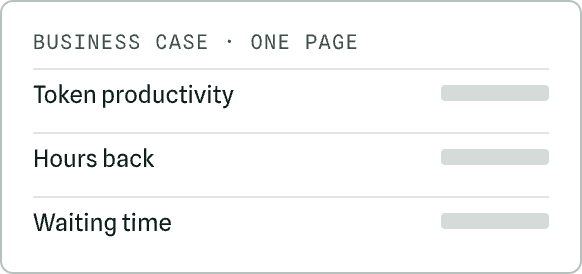
The case built on your token spend, hourly rates, and cycle time.
A one-page business case
-
Exec demo
Built with you, on your own decisions and tickets.
A custom demo for the exec visit
-
Security review
Brief runs in our cloud by default. On the Enterprise plan:
Documentation in the Trust Center


Give every agent the context
your org already decided
One context graph for every agent and every person in your product org.