Building AI that understands product impact, not just code quality
A technical deep dive into context-aware AI systems that bridge the gap between shipping fast and shipping right
If you've been using Cursor, Claude, or Copilot for development, you've probably experienced this: your AI can write beautiful, functional code in minutes. It understands patterns, follows best practices, and rarely introduces bugs. But ask it whether you should build that feature in the first place, and you get silence.
The problem isn't code quality anymore—it's product sense. Modern AI development tools have solved the "how" but completely missed the "why." This creates a dangerous feedback loop where teams ship faster than ever while simultaneously drifting further from their actual business objectives.
After building Brief, a context layer that helps AI understand business decisions, we've learned that the gap between "AI that codes" and "AI that builds products" isn't just about training better models. It's about fundamentally rethinking how we structure and deliver context to AI systems.
The Context Problem: Why Fast Code ≠ Good Product
Traditional AI coding assistants operate in a context vacuum. They see your current file, maybe your repository structure, and potentially some recent changes. But they don't see:
- Why this feature exists in the first place
- What customer problem it's supposed to solve
- How it fits into your broader product strategy
- What constraints or decisions shaped its design
- Whether building it now aligns with your goals
This leads to what we call "agentic whiplash"—teams that can implement any feature in hours but constantly pivot because their AI lacks the product intelligence to guide those decisions.
The solution isn't better code generation. It's building AI systems that understand product impact alongside technical implementation.
Architecture: Context as Infrastructure
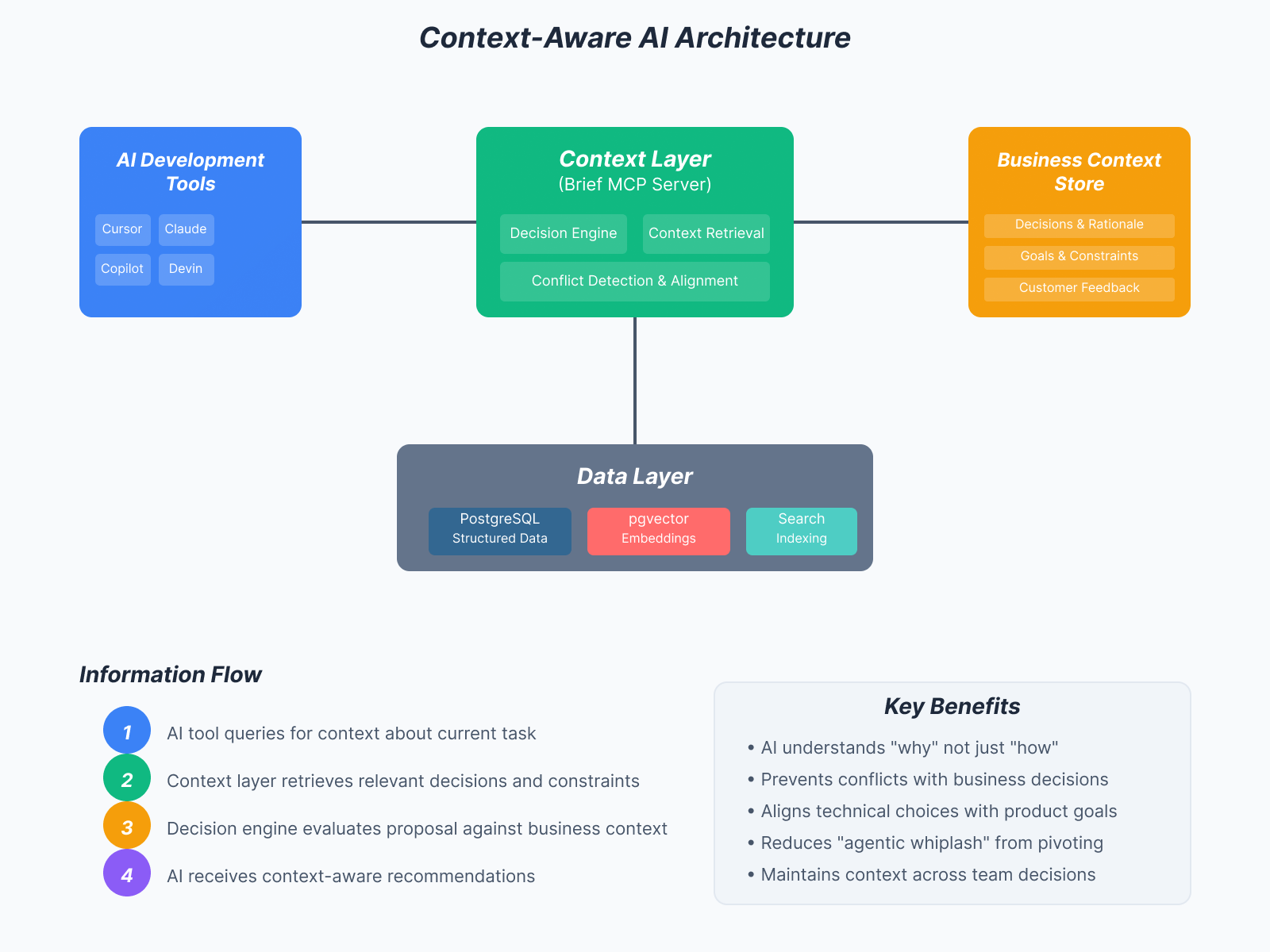
Building product-aware AI requires treating context as infrastructure, not an afterthought. Here's the architecture we developed for Brief:
┌─────────────────┐    ┌──────────────────┐    ┌─────────────────┐
│   AI Tool       │    │   Context Layer  │    │   Business      │
│  (Cursor/Claude)│◄──►│     (Brief)      │◄──►│   Context       │
│                 │    │                  │    │   Store         │
└─────────────────┘    └──────────────────┘    └─────────────────┘
                              │
                              ▼
                       ┌──────────────────┐
                       │   Decision       │
                       │   Engine         │
                       └──────────────────┘
Component 1: Business Context Store
The foundation is a structured repository of business context that goes beyond code:
interface BusinessContext {
  decisions: Decision[];
  constraints: Constraint[];
  goals: Goal[];
  customerFeedback: Feedback[];
  technicalDebt: TechnicalDebt[];
}

interface Decision {
  id: string;
  category: 'tech' | 'product' | 'design' | 'process';
  decision: string;
  rationale: string;
  severity: 'info' | 'important' | 'blocking';
  timestamp: Date;
  tags: string[];
}
We store decisions as first-class entities because they represent the "why" behind every line of code. When an AI understands that "we chose React over Vue because our team has React expertise" or "we're not adding new database tables until we resolve the performance issues," it makes fundamentally different recommendations.
Component 2: Context Retrieval Engine
Raw context isn't enough—you need intelligent retrieval that surfaces relevant context based on what the AI is working on:
class ContextRetriever {
  async getRelevantContext(
    query: string,
    scope: 'file' | 'feature' | 'epic'
  ): Promise<ContextResponse> {
    // Semantic search using embeddings
    const semanticMatches = await this.vectorSearch(query);

    // Keyword matching for exact decision references
    const exactMatches = await this.keywordSearch(query);

    // Hierarchical context (feature → epic → roadmap)
    const hierarchicalContext = await this.getHierarchicalContext(scope);

    return this.rankAndFilter({
      semantic: semanticMatches,
      exact: exactMatches,
      hierarchical: hierarchicalContext
    });
  }

  private async vectorSearch(query: string): Promise<ContextMatch[]> {
    const embedding = await this.embeddings.create(query);

    const { data } = await this.supabase
      .from('context_embeddings')
      .select('*')
      .rpc('match_context', {
        query_embedding: embedding.data[0].embedding,
        match_threshold: SIMILARITY_THRESHOLD,
        match_count: MAX_RESULTS
      });

    return data;
  }
}
The key insight: different types of queries need different retrieval strategies. A question about implementation details needs different context than a question about feature priority.
Component 3: Decision Engine
This is where product sense emerges. The decision engine evaluates AI suggestions against your business context:
class ProductDecisionEngine {
  async evaluateProposal(
    proposal: CodeProposal,
    context: BusinessContext
  ): Promise<DecisionResult> {
    const conflicts = await this.checkConflicts(proposal, context);
    const alignment = await this.assessAlignment(proposal, context);
    const impact = await this.estimateImpact(proposal, context);

    return {
      recommendation: this.generateRecommendation(conflicts, alignment, impact),
      reasoning: this.explainReasoning(conflicts, alignment, impact),
      alternatives: await this.suggestAlternatives(proposal, context)
    };
  }

  private async checkConflicts(
    proposal: CodeProposal,
    context: BusinessContext
  ): Promise<Conflict[]> {
    const blockingDecisions = context.decisions.filter(d =>
      d.severity === 'blocking' &&
      this.proposalConflicts(proposal, d)
    );

    return blockingDecisions.map(d => ({
      type: 'blocking_decision',
      decision: d,
      explanation: `This conflicts with decision ${d.id}: ${d.decision}`
    }));
  }
}
Implementation: MCP Integration Pattern
We built Brief as an MCP (Model Context Protocol) server that integrates with existing AI tools. This pattern lets you add product intelligence to any AI system without rebuilding everything:
// MCP Server Implementation
export class BriefMCPServer extends MCPServer {
  async handleToolCall(name: string, args: any): Promise<any> {
    switch (name) {
      case 'brief_get_context':
        return this.getRelevantContext(args.query, args.scope);

      case 'brief_check_decision':
        return this.checkAgainstDecisions(args.proposal);

      case 'brief_record_decision':
        return this.recordNewDecision(args.decision);

      default:
        throw new Error(`Unknown tool: ${name}`);
    }
  }

  private async getRelevantContext(
    query: string,
    scope: string
  ): Promise<ContextResponse> {
    const retriever = new ContextRetriever(this.database);
    const context = await retriever.getRelevantContext(query, scope);

    return {
      decisions: context.decisions,
      constraints: context.constraints,
      recommendations: await this.generateRecommendations(context)
    };
  }
}
The MCP pattern is powerful because it creates a standard interface between AI tools and business context. Any tool that supports MCP can instantly access your product intelligence.
Data Layer: Making Context Queryable
The technical challenge isn't just storing context—it's making it efficiently queryable by AI systems. We use a hybrid approach with PostgreSQL and vector embeddings:
-- Core decision storage
CREATE TABLE decisions (
  id UUID PRIMARY KEY,
  category decision_category,
  decision TEXT NOT NULL,
  rationale TEXT NOT NULL,
  severity severity_level,
  created_at TIMESTAMP DEFAULT NOW(),
  tags TEXT[]
);

-- Vector embeddings for semantic search
CREATE TABLE decision_embeddings (
  decision_id UUID REFERENCES decisions(id),
  embedding VECTOR(1536),
  content TEXT
);

-- Semantic search function
CREATE OR REPLACE FUNCTION match_decisions(
  query_embedding VECTOR(1536),
  match_threshold FLOAT,
  match_count INT
)
RETURNS TABLE (
  decision_id UUID,
  decision TEXT,
  similarity FLOAT
)
LANGUAGE plpgsql
AS $$
BEGIN
  RETURN QUERY
  SELECT
    de.decision_id,
    d.decision,
    (1 - (de.embedding <=> query_embedding)) AS similarity
  FROM decision_embeddings de
  JOIN decisions d ON de.decision_id = d.id
  WHERE (1 - (de.embedding <=> query_embedding)) > match_threshold
  ORDER BY similarity DESC
  LIMIT match_count;
END;
$$;
Context Integration Patterns
Pattern 1: Just-in-Time Context
Load context when the AI is about to make a decision:
async function enhanceAIPrompt(
  originalPrompt: string,
  codeContext: string
): Promise<string> {
  const relevantContext = await brief.getContext({
    query: originalPrompt,
    codeContext,
    scope: 'feature'
  });

  return `
${originalPrompt}

BUSINESS CONTEXT:
${relevantContext.decisions.map(d => `- ${d.decision}: ${d.rationale}`).join('\n')}

CURRENT CONSTRAINTS:
${relevantContext.constraints.map(c => `- ${c.description}`).join('\n')}

Consider this context when providing your response.
  `;
}
Pattern 2: Proactive Conflict Detection
Check proposals against your decision history before implementation:
async function validateProposal(proposal: string): Promise<ValidationResult> {
  const conflicts = await brief.checkConflicts(proposal);

  if (conflicts.length > 0) {
    return {
      approved: false,
      conflicts,
      suggestions: await brief.getAlternatives(proposal)
    };
  }

  return { approved: true };
}
Pattern 3: Learning from Outcomes
Update your context based on how decisions play out:
async function recordOutcome(
  decisionId: string,
  outcome: 'successful' | 'failed' | 'neutral',
  learnings: string[]
): Promise<void> {
  await brief.recordDecision({
    decision: `Outcome of ${decisionId}: ${outcome}`,
    rationale: learnings.join('. '),
    category: 'process',
    severity: 'info'
  });
}
Measuring Impact: Metrics That Matter
Traditional metrics (code quality, velocity) don't capture product alignment. We focus on measuring business context utilization:
interface ProductAlignmentMetrics {
  contextUtilization: number; // How often AI queries context
  decisionConflicts: number;  // Conflicts caught before implementation
  pivotReduction: number;     // Reduction in feature pivots
  goalAlignment: number;      // Features that map to stated goals
}

class MetricsCollector {
  async trackContextQuery(query: string, results: ContextResponse) {
    await this.analytics.track('context_query', {
      query_type: this.classifyQuery(query),
      results_count: results.decisions.length,
      utilization_pattern: this.analyzeUtilization(results)
    });
  }

  async trackDecisionConflict(proposal: string, conflicts: Conflict[]) {
    await this.analytics.track('conflict_detected', {
      conflict_severity: this.assessSeverity(conflicts),
      resolution_path: 'prevented'
    });
  }
}
Implementation Challenges and Solutions
Challenge 1: Context Staleness
Business context changes faster than code. Stale decisions can mislead AI systems.
Solution: Implement context freshness scoring and automatic expiration:
interface ContextFreshness {
  lastUpdated: Date;
  relevanceScore: number;
  expirationDate?: Date;
}

function calculateFreshness(decision: Decision): number {
  const age = Date.now() - decision.timestamp.getTime();
  const daysSinceCreation = age / (1000 * 60 * 60 * 24);

  // Exponential decay based on decision category
  const decayRate = DECAY_RATES[decision.category];

  return Math.exp(-decayRate * daysSinceCreation);
}
Challenge 2: Context Overload
Too much context can confuse AI systems as much as too little.
Solution: Implement smart context ranking and filtering:
function rankContext(
  contexts: ContextMatch[],
  query: string
): ContextMatch[] {
  return contexts
    .map(c => ({
      ...c,
      // Combine multiple scoring dimensions
      compositeScore: this.calculateCompositeScore(c, query)
    }))
    .sort((a, b) => b.compositeScore - a.compositeScore)
    .slice(0, MAX_CONTEXT_ITEMS);
}

private calculateCompositeScore(context: ContextMatch, query: string): number {
  // Weighted combination of relevance, freshness, and importance
  // Implementation varies based on context type and query characteristics
  return this.weightedScore([
    this.calculateRelevance(context, query),
    this.calculateFreshness(context.decision),
    this.getImportanceScore(context.decision.severity)
  ]);
}
Challenge 3: Cross-Team Context
Different teams have different contexts that need to be reconciled.
Solution: Implement hierarchical context inheritance:
interface ContextHierarchy {
  global: BusinessContext;    // Company-wide decisions
  team: BusinessContext;      // Team-specific decisions
  project: BusinessContext;   // Project-specific decisions
}

async function getEffectiveContext(
  scope: 'global' | 'team' | 'project',
  teamId: string,
  projectId: string
): Promise<BusinessContext> {
  const contexts = await Promise.all([
    this.getGlobalContext(),
    this.getTeamContext(teamId),
    this.getProjectContext(projectId)
  ]);

  // Merge contexts with project overriding team overriding global
  return this.mergeContexts(contexts, ['global', 'team', 'project']);
}
The Future: Context-Native Development
What we're building toward isn't just smarter AI tools—it's a fundamentally different development paradigm where context and code evolve together.
In context-native development:
- Every line of code carries business rationale
- AI systems understand not just what to build, but why
- Technical decisions automatically align with product strategy
- Teams ship fast and ship right
The technical patterns we've shared are just the beginning. As AI tools become more sophisticated, the teams that win will be those that solve the context problem first.
Your AI doesn't know why you're building this. But it could.
Want to see these patterns in action? Brief provides production-ready context infrastructure for AI development teams. Learn more at briefhq.ai or reach out at hello@briefhq.ai.
← Back to Blog